
20 Essential Multithreading Concepts Explained in 15 Minutes
Deadlock, Livelock, Race condition and much more


Want to learn System Design in Depth? Join ByteByteGo now for visual learning. They are also offering a rare 50% discount now on their lifetime plan

credit --- ByteByteGo
Hello friends, If you’re preparing for Java interviews, building high-performance backend systems, or simply want to write faster and safer concurrent applications, multithreading is one topic you can’t afford to ignore.
Modern applications rarely run a single task at a time. Web servers handle thousands of requests simultaneously, messaging systems process events in parallel, and cloud applications execute multiple background jobs concurrently.
Understanding multithreading helps you build software that makes efficient use of CPU resources while remaining correct and scalable.
In this article, we’ll walk through 20 essential multithreading concepts that every Java developer should know. Think of this as a quick roadmap — each concept is explained in simple terms, along with where you’ll encounter it in real-world applications.
Educative Premium Plus (60% OFF) (Sponsored)

When it comes to System Design and Coding Interview, Educative.io is one of the most trusted resources. I have used many of their System Design, Algorithms and Coding interview pattern courses to crack coding interviews multiple times.
Since, last year, they are also creating amazing AI content, particularly on Agentic AI and AI System Design. If you want to level up your System design and AI skills and join Educative, now if the perfect time as they are offering a limited time 60% discount on their 2-year Premium Plus Plan.
This provides best value as you get a discounted rate for 2 years and I highly recommend it.
20 Multithreading and Concurrency Concepts Every Developer Should Learn
Here are the 12 important System Design patterns I learned and mastered by going through different System Design resources. Once you understand these concepts, half the battle is already one.
1. Process vs Thread
A process is an independent program running in memory, while a thread is the smallest unit of execution inside a process.
A process has its own memory space, whereas threads within the same process share memory, making communication much faster.
Example: A web browser is a process. Each tab or background task may run in its own thread.
Key Takeaway: Threads are lightweight and share resources; processes are isolated.
2. Creating Threads
Java provides multiple ways to create threads:
Extending the
ThreadclassImplementing the
RunnableinterfaceImplementing
CallableUsing
ExecutorService(recommended)
Today, developers rarely create threads manually. Instead, they submit tasks to thread pools.
Best Practice: Prefer ExecutorService over directly creating threads.
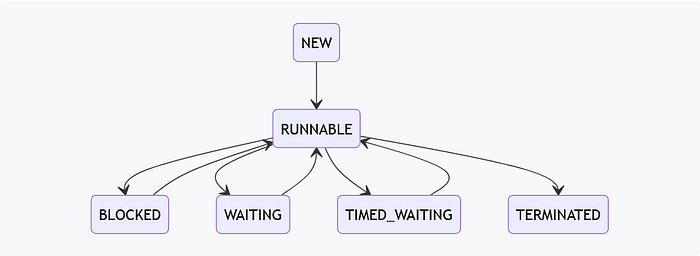
3. Thread Lifecycle
Every Java thread goes through several states:
NEW
RUNNABLE
BLOCKED
WAITING
TIMED_WAITING
TERMINATED
Understanding these states helps when debugging thread dumps or performance issues.
4. Thread Scheduling
The JVM relies on the operating system to schedule threads.
There is no guarantee that higher-priority threads always execute first.
Methods like yield() and thread priorities should not be relied upon for application logic.
Rule: Never assume execution order.
5. Race Condition
A race condition occurs when multiple threads access shared data simultaneously, and the final result depends on the timing of execution.
Example:

 | A guest post by
|