
SOLID Principles Explained for Modern Developers (2026 Edition)
Deep Dive into SOLID principles in Programming


Preparing for System Design Interviews? Join ByteByteGo now for a structured preparation. They are also offering a rare 50% discount now on their lifetime plan.
Hello guys, System design and career growth often look very different in theory than in real life. In this post, we explore practical insights shaped by real-world engineering experience and shared by one of FAANG engineer.
As software engineers, we all know code review is a critical part of building robust, maintainable, and scalable systems. It’s not just about finding bugs; it’s about fostering shared understanding, spreading knowledge, and improving code quality.
And when it comes to quality, few concepts are as powerful as SOLID.
SOLID is an acronym for five fundamental principles of object-oriented design proposed by Robert C. Martin (Uncle Bob) in his classic Clean Code book.
While they might seem theoretical, they are incredibly practical, especially when you’re scrutinizing a pull request. If you don’t know SOLID or have some idea about SOLID but not sure how to apply in real world coding then this post is for you.
📣Educative.io (Sponsored)

Educative.io is one of the most trusted platforms for learning system design, coding interviews, backend development, cloud, and AI engineering. It offers over 1,500 interactive courses, hands-on labs, real-world projects, and structured learning paths created by industry experts.
If you have been planning to upskill in system design, distributed systems, data engineering, or AI, this is a rare opportunity to get full access at a significantly reduced price. The offer is available for a limited time, so it is worth taking advantage of it before the sale ends.
This guest article is written by Hemant Pandey , Senior Software Engineer and Tech Lead, formerly at Facebook, Salesforce, and Tesla. Hemant writes about career growth, studying abroad, and life experiences, and is the author of The Hustling Engineer newsletter.
With that I hand over to Hemant to take you through rest of the article.
Robert C. Martin grouped these 5 principles under the acronym “SOLID” in the early 2000s. The acronym was first mentioned in a 2004 paper, Design Principles and Design Patterns

Let’s dive deep into each of these
1. Single Responsibility Principle (SRP)
Definition
A class should have only one reason to change, meaning it should have only one responsibility or job.
Why It’s Important
If a class has multiple responsibilities, a change in one responsibility might require changes in the other. This can lead to tightly coupled code, making it harder to maintain, test, and understand.
Detailed Example:
Let’s consider an example where a User class handles both authentication and data management.
Initially, it might seem convenient to put everything in one class:
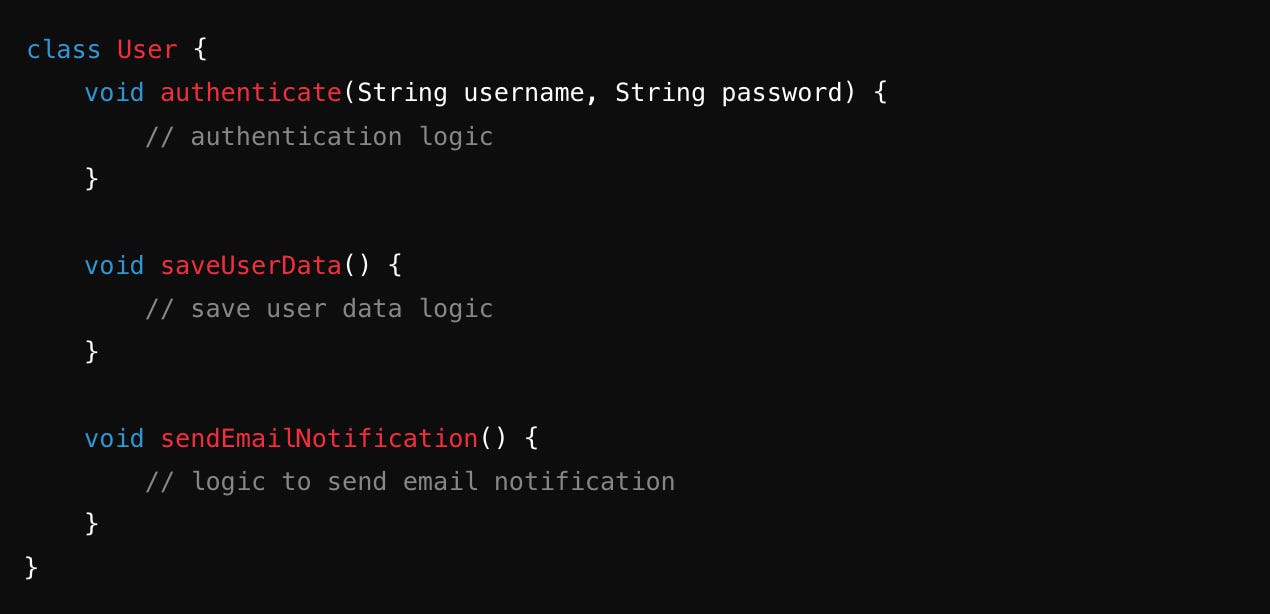
This User class is now responsible for:
Authentication
Managing user data.
Sending notifications.
If you need to change how notifications are sent, you’d have to modify the User class, potentially breaking something else.
To follow SRP, you can split this into three different classes:
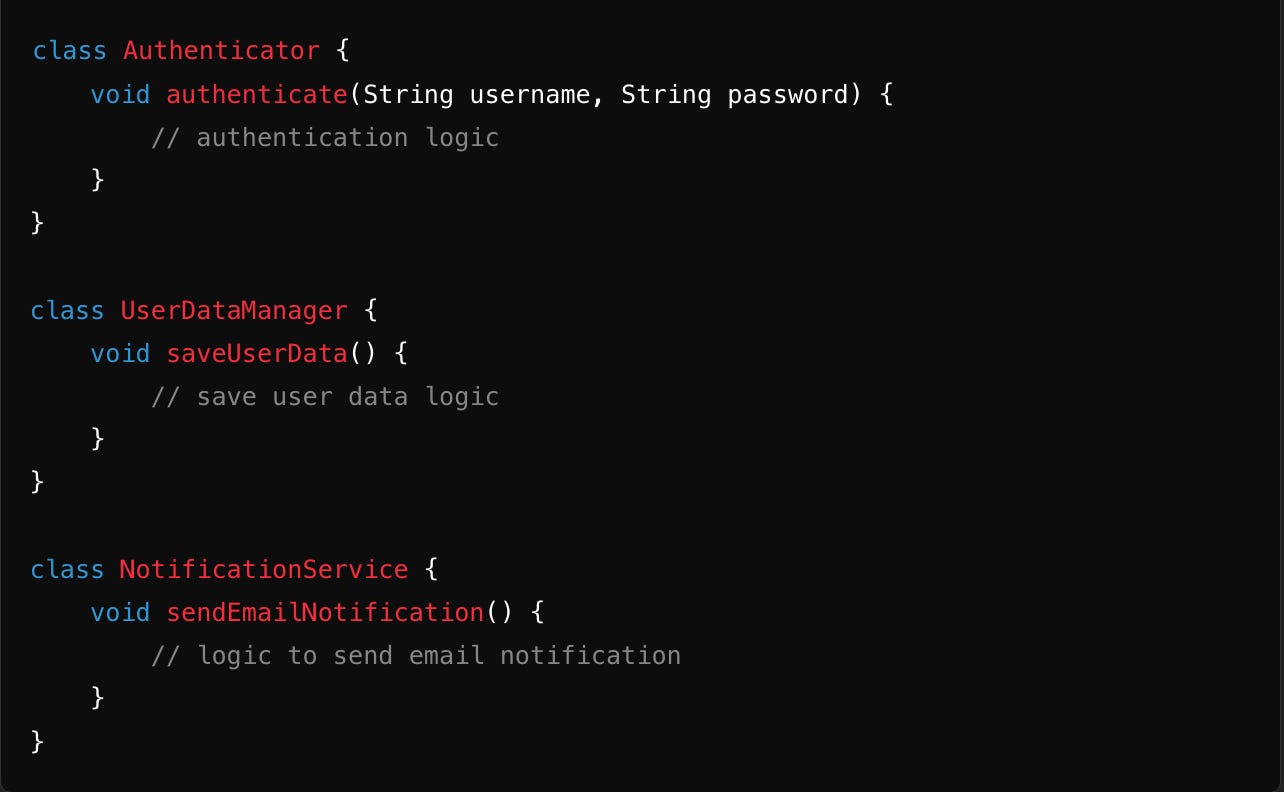
Now, each class has a single responsibility:
Authenticatorhandles authentication.UserDataManagerhandles user data.NotificationServicehandles notifications.
The code becomes easier to manage, test, and extend.
2. Open/Closed Principle (OCP)
Definition
Software entities like classes, modules, and functions should be open for extension but closed for modification.
Why It’s Important
When a class is closed for modification, you reduce the risk of introducing bugs into existing functionality. Instead of modifying existing code, you add new code, which is easier to test and integrate.
Detailed Example
Consider a scenario where we want to calculate the area of different shapes. Initially, you might write something like this:
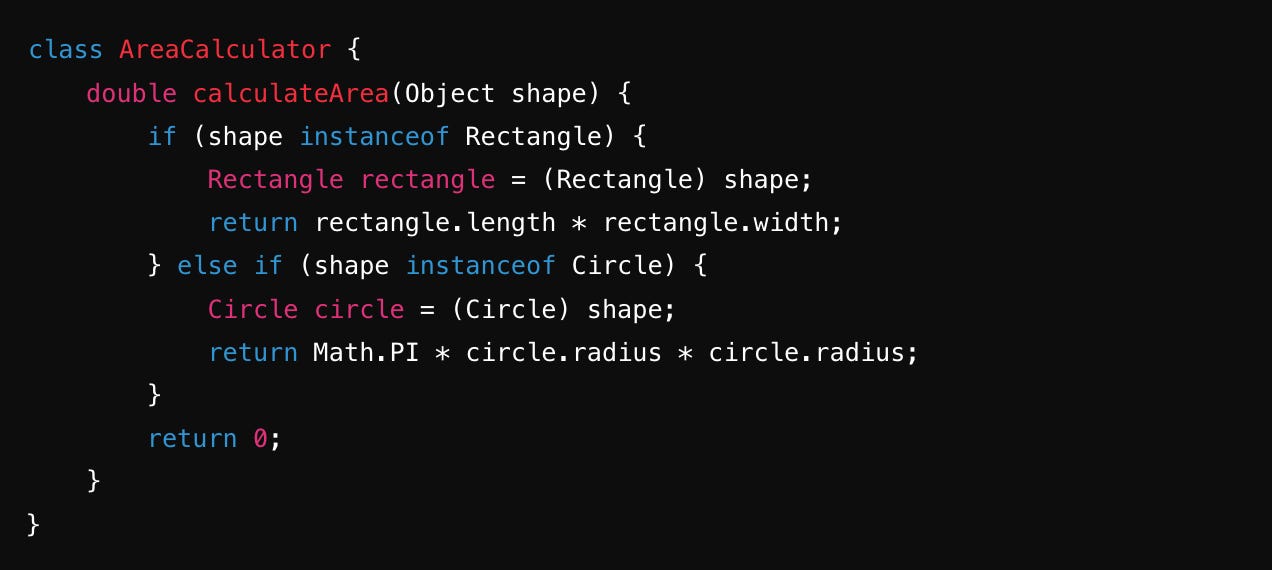
This approach violates the OCP because every time a new shape is added, you need to modify the AreaCalculator class, increasing the risk of errors.
A better approach here is
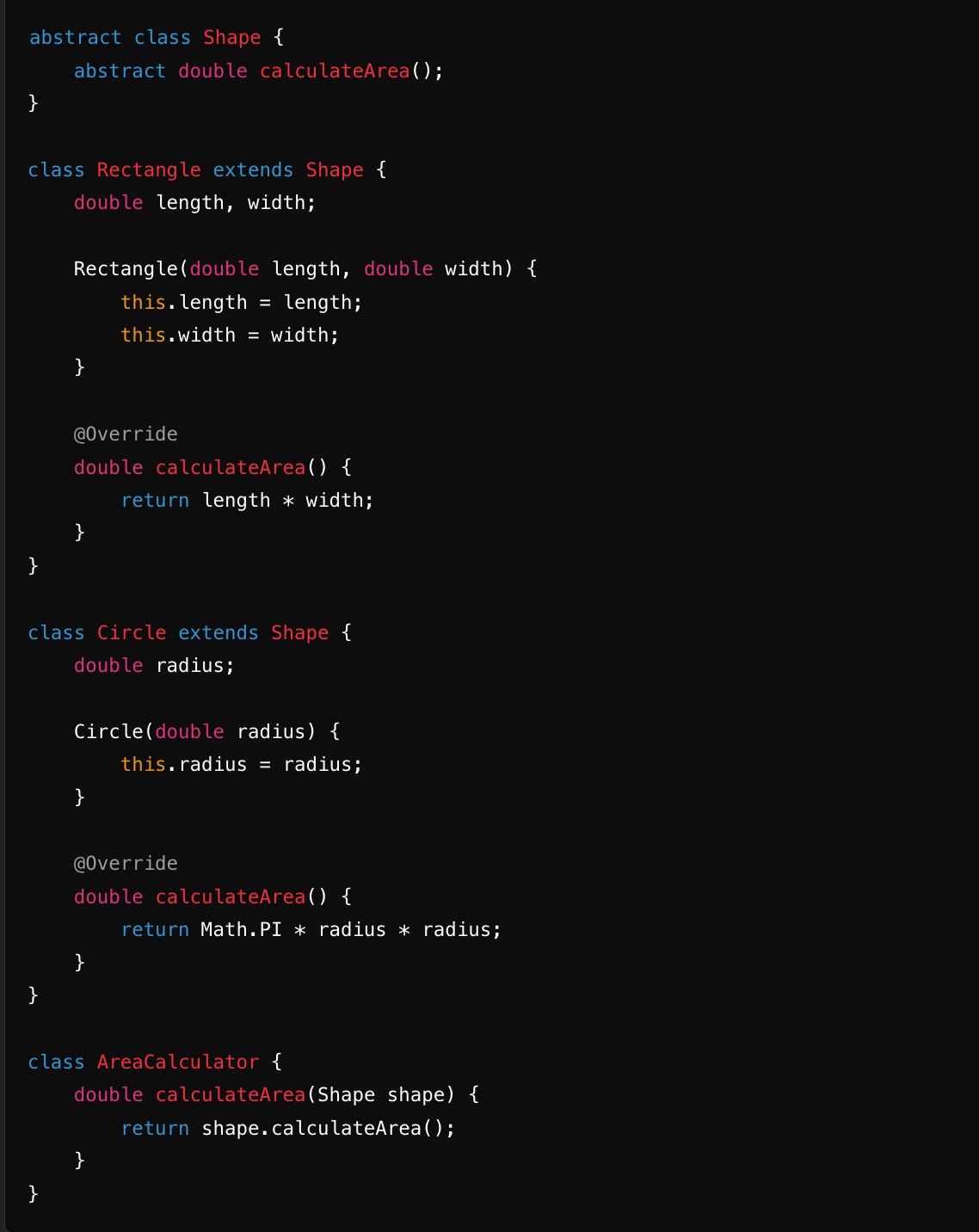
Now, if you want to add a new shape, such as a Triangle, you simply create a new class extending Shape:
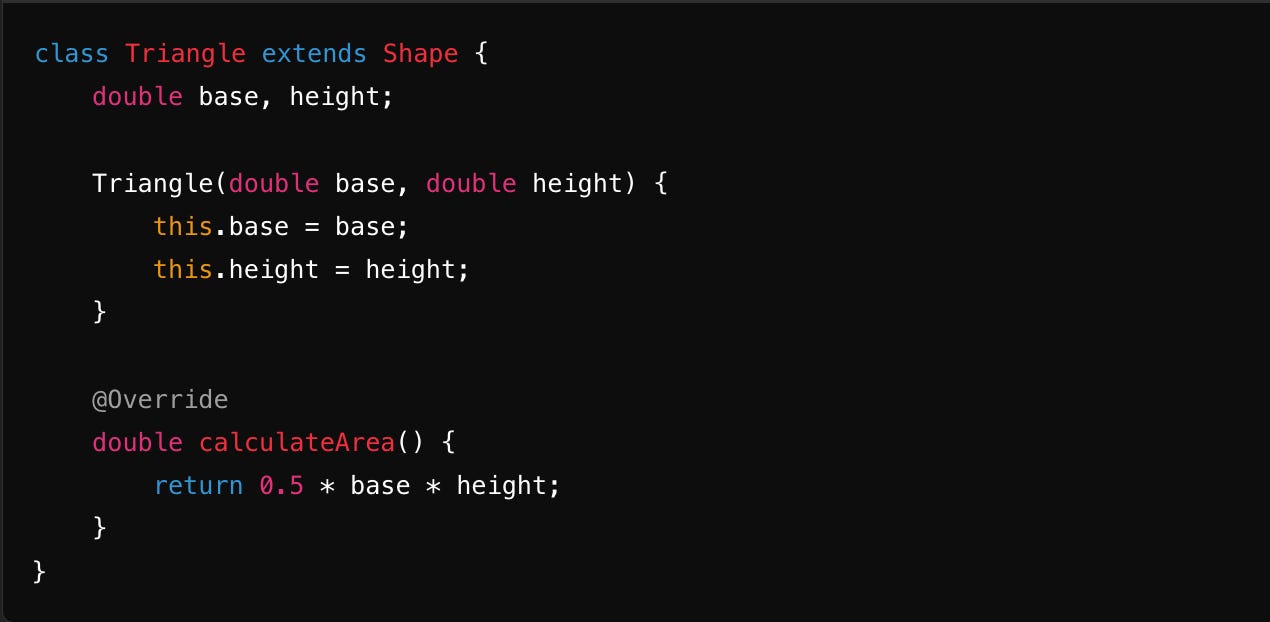
The AreaCalculator class doesn’t need to be modified.
3. Liskov Substitution Principle (LSP)
Definition
Subtypes must be substitutable for their base types without altering the correctness of the program.
Why It’s Important
If derived classes violate the expectations set by the base class, it can lead to unexpected behavior, making the code less reliable and harder to understand.
Detailed Example
Consider the example of birds. If you have a base class Bird with a fly method, you might assume that all birds can fly. However, not all birds can fly, so this assumption is flawed:
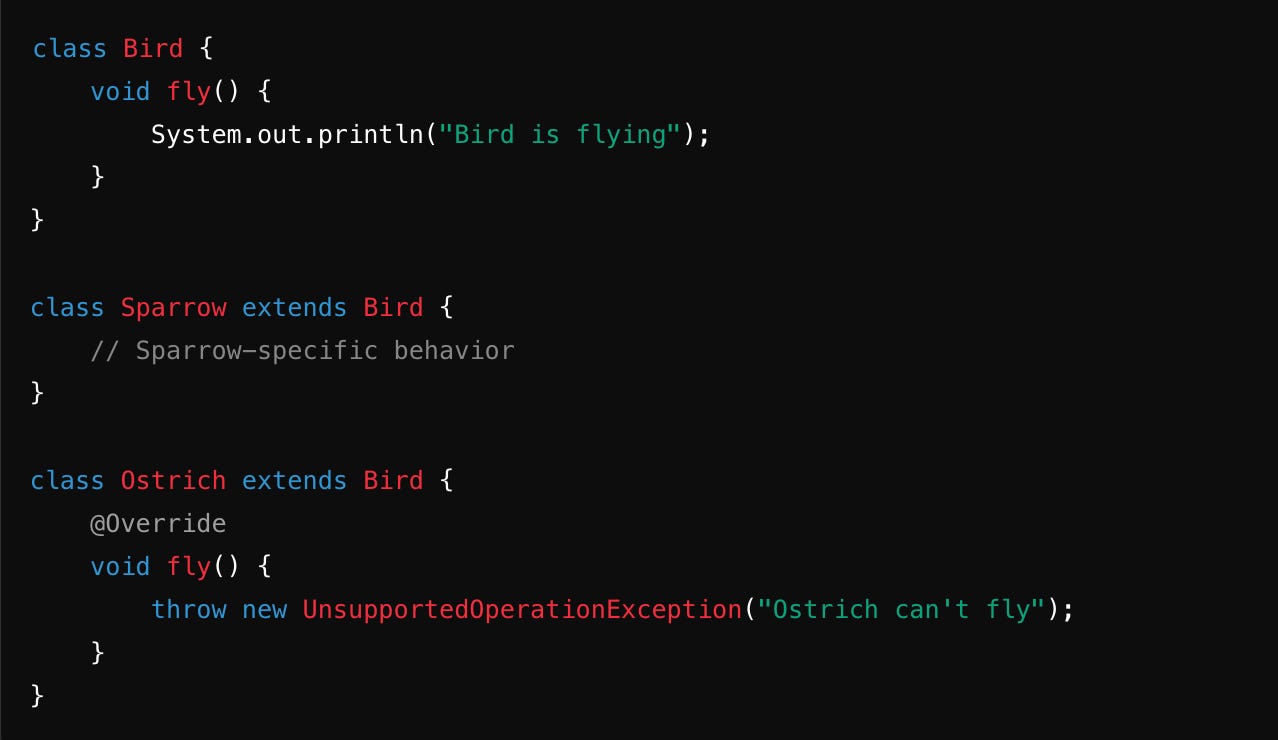
If you try to substitute Ostrich for Bird, it will break the program:

To adhere to LSP, you can create a more accurate class hierarchy:
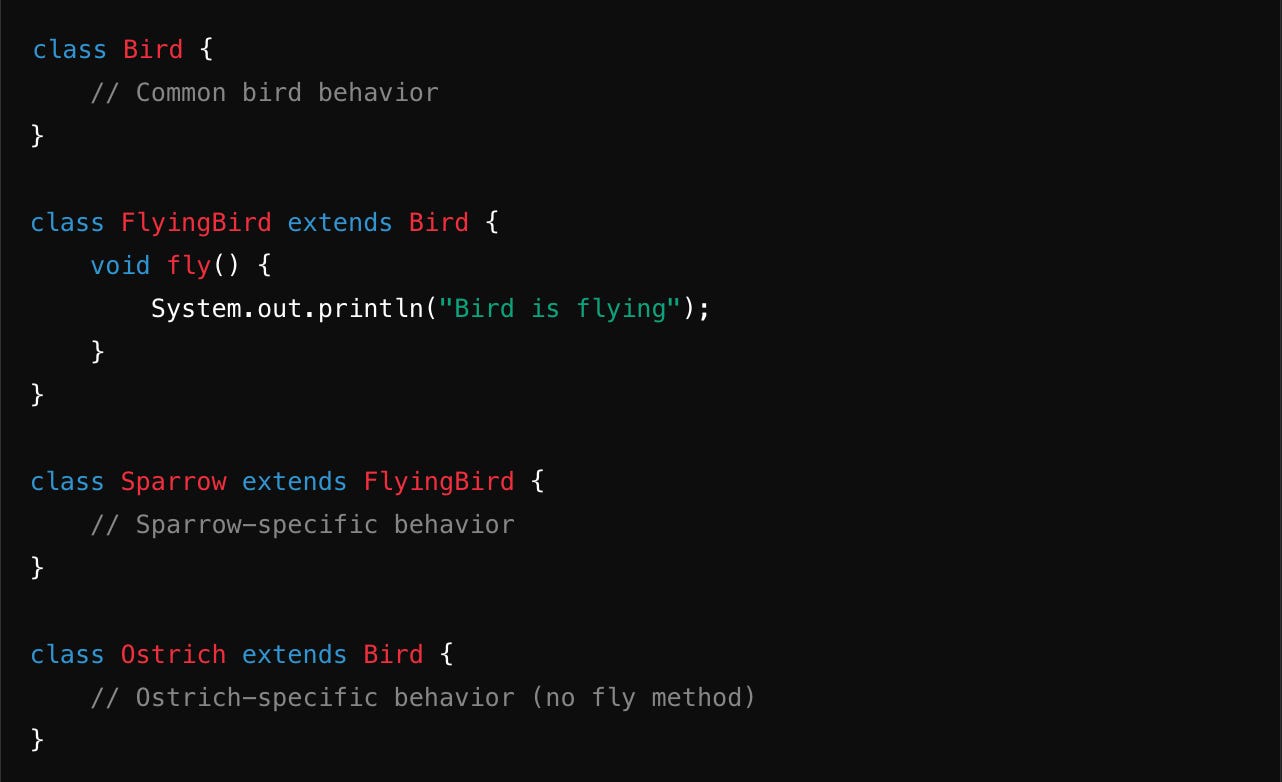
Now, substituting a Sparrow or Ostrich for Bird doesn’t violate the expectations set by the base class.
4. Interface Segregation Principle (ISP)
Definition
A client should not be forced to depend on interfaces it does not use.
Why It’s Important
Large interfaces are harder to implement and maintain. By splitting them into smaller, more specific interfaces, you make your code more modular, flexible, and easier to understand.
Detailed Example
Let’s say you have a Worker interface that includes both working and eating behaviors

Now, suppose you have a HumanWorker and a RobotWorker. The RobotWorker doesn’t need to implement the eat method, but it’s forced to do so:
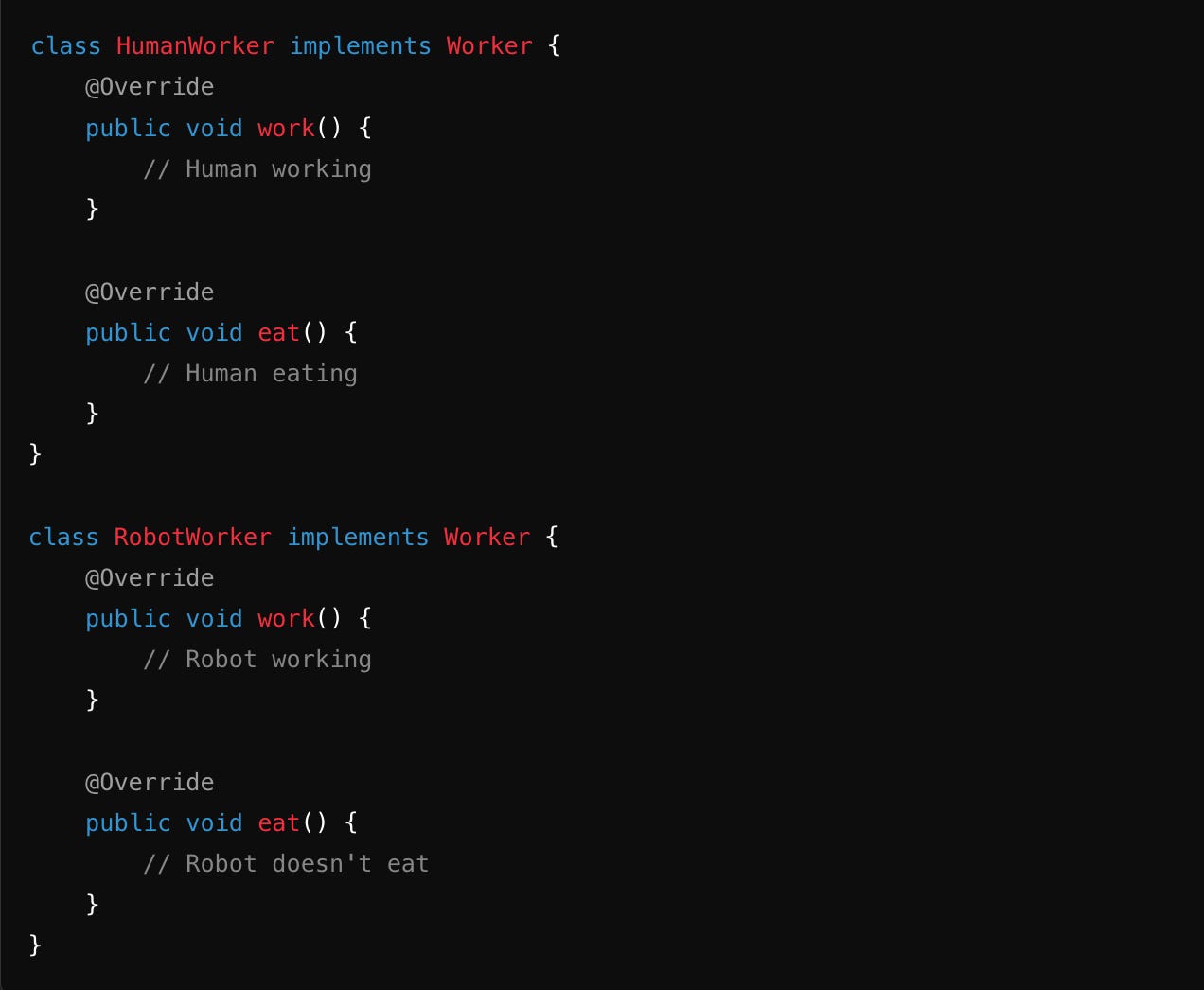
To follow ISP, you should split the interface:
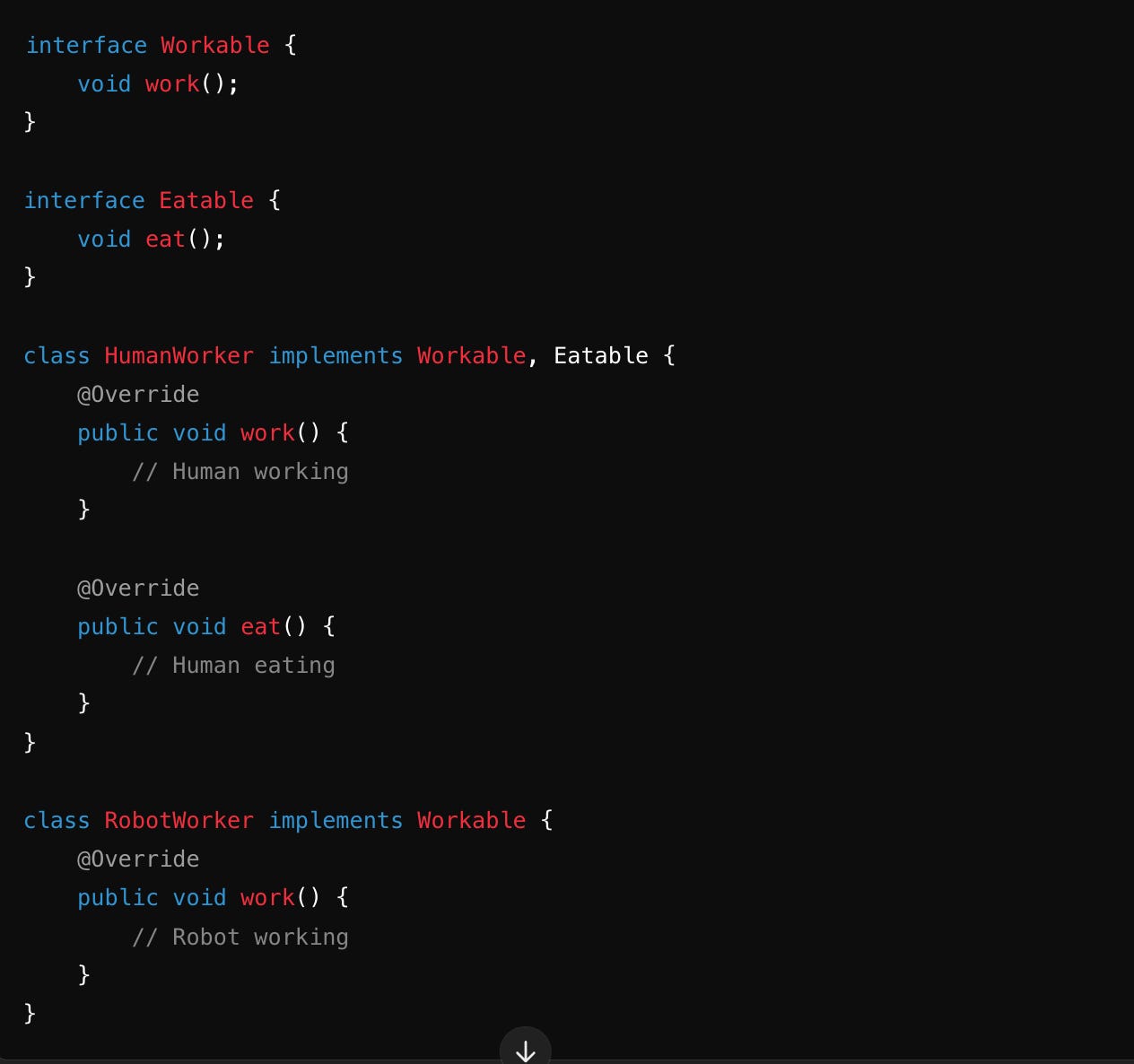
Now, RobotWorker only implements what it needs (Workable), making the code cleaner and more flexible.
5. Dependency Inversion Principle (DIP)
Definition
High-level modules should not depend on low-level modules. Both should depend on abstractions. Additionally, abstractions should not depend on details; details should depend on abstractions.
Why It’s Important
By depending on abstractions, you make your code more modular, testable, and easier to maintain. It allows for easier swapping of implementations without affecting the higher-level logic.
Detailed Example
Consider a scenario where a LightSwitch class directly depends on a LightBulb
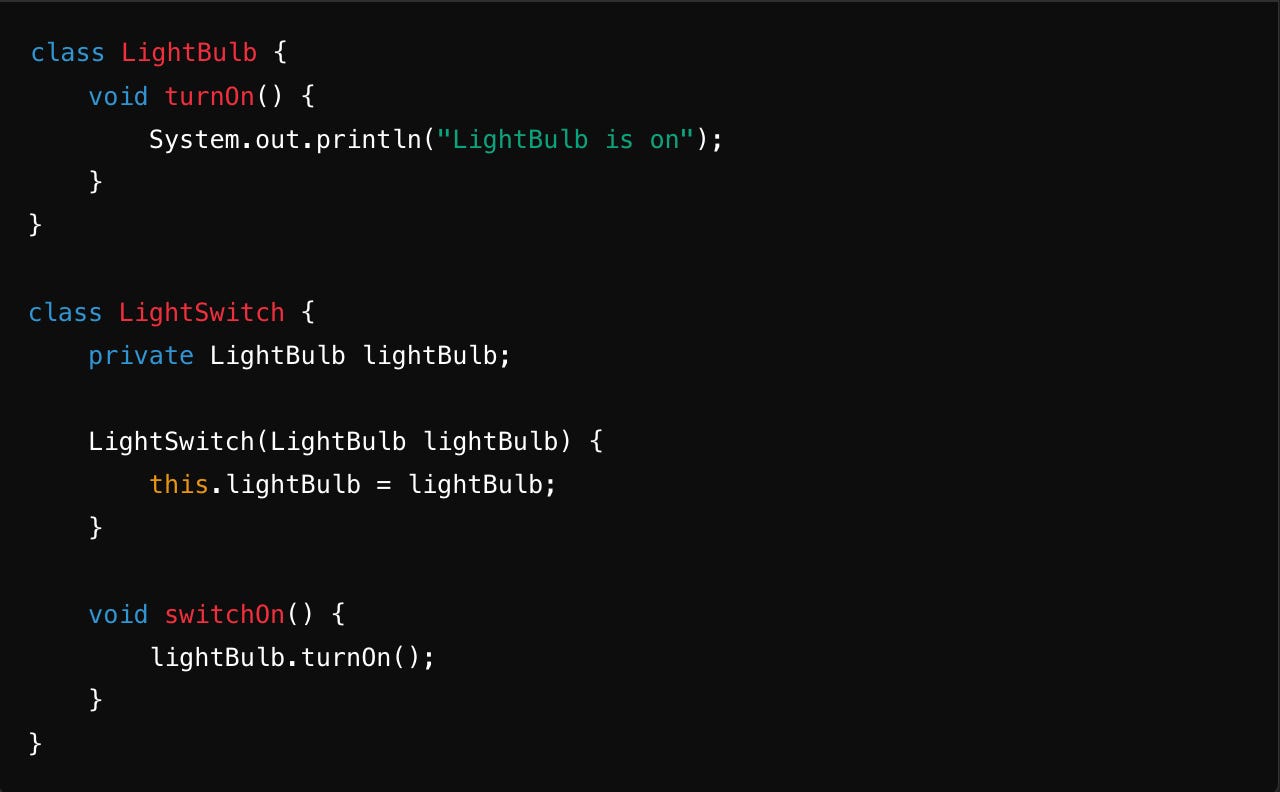
In this case, the LightSwitch class is tightly coupled to the LightBulb implementation. If you want to switch to a different type of light, you’d have to modify the LightSwitch class.
To follow DIP, you can introduce an abstraction (Switchable interface):
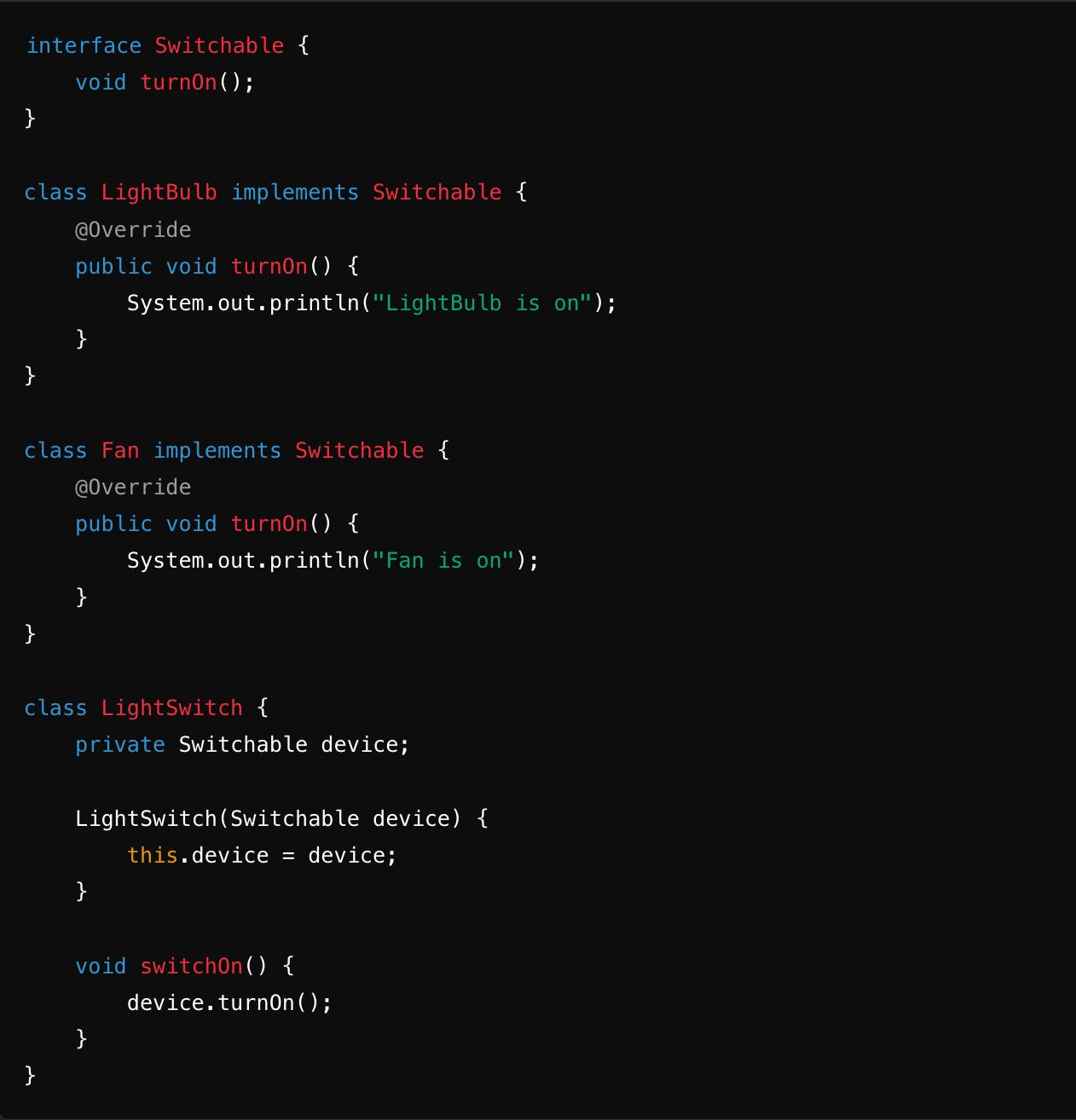
Now, the LightSwitch class depends on the Switchable interface, not a specific implementation like LightBulb. This makes it easy to change or extend functionality without modifying the LightSwitch class.
For example, you can switch to a Fan without altering the LightSwitch

This approach adheres to DIP by ensuring that high-level modules depend on abstractions, promoting loose coupling and greater flexibility in the code.
By understanding and applying these SOLID principles, you can significantly improve the design, maintainability, and scalability of your code. Each principle helps in addressing common software design problems, making your code more robust and easier to work with.
If you like this article, please share and repost so it reaches more folks. You can hit the like ❤️ button at the bottom of this email to support and don’t forget to subscribe to my substack

Other Articles you may like:


 | A guest post by
|