
System Design Interview Question – Parking Lot Design
How to design Parking Lot in a System Design Interview

[SPONSORED] AI writes code. WaveMaker makes it deterministic.

Most AI coding tools treat code generation like autocomplete at scale. WaveMaker treats it like engineering.
Their 2-pass model:
• Pass 1: AI converts your intent into structured markup
• Pass 2: A deterministic code generator produces production-ready output — identically, every time
The result: the speed of AI without the unpredictability. Your design system becomes the guardrail AI works within. No hallucinations. No drift. Built for teams where architectural consistency isn’t optional.
Try it out now → wavemaker.ai
Hello guys, one of the main challenge of coding interview is System design round where you are asked to design a real world system. While it may easy it can quickly become a nightmare if you don’t know a structured way to solve the problem.
In the past, I have shared both approach and solution of many popular System Design problems like URL Shrotner, Twitter Design, and WhatsApp Design, and today we will talk about how to design parking lot.
Parking lots might seem simple in everyday life—you drive in, find a spot, park, and leave.
But when you scale this up to a company operating 1000s of parking lots across multiple countries, each with different parking spot types and reservation needs, it quickly becomes a fascinating system design problem.
In this post, we’ll walk through designing a Parking Lot Reservation System that allows users to reserve, pay, and park while ensuring scalability, consistency, and availability across a global operation.
Step 1: System Requirements
Let’s start with the basics requirements for this question, in actual interview you make sure to clarify requirements.
Functional Requirements
User can reserve a parking spot.
User pays for the reservation.
User can park a car on the reserved spot.
User can leave before the reservation expires.
Parking lots support three types of spots:
Compact size
Standard size
With electric charger
Handle no-show cases: if a user books but doesn’t show up, charge them for 24 hours.
Non-Functional Requirements
Scalability: System must handle 1000s of parking lots across countries.
High Availability: Critical for real-time reservations and payments.
Strong Consistency: No double-booking of spots.
Step 2: Capacity Estimation
Geography: 10 countries, ~100 lots per country → 1000 parking lots.
Capacity: ~200 cars per lot (70% standard, 20% compact, 10% EV with chargers).
Usage Pattern:
80% short-term (avg 4 hrs).
20% long-term (avg 5 days).
Requests: ~50 reservations/day per lot → 50,000 reservations/day system-wide.
Data Estimate
Each reservation ≈ 40 bytes (User ID, car type, start time, end time).
Daily: 50k × 40 bytes ≈ 400 KB/day.
2 years: ≈ 292 MB total.
This comfortably fits into a Relational Database (RDBMS), which ensures strong consistency—critical for preventing double bookings.
Step 3: API Design
User-Facing APIs
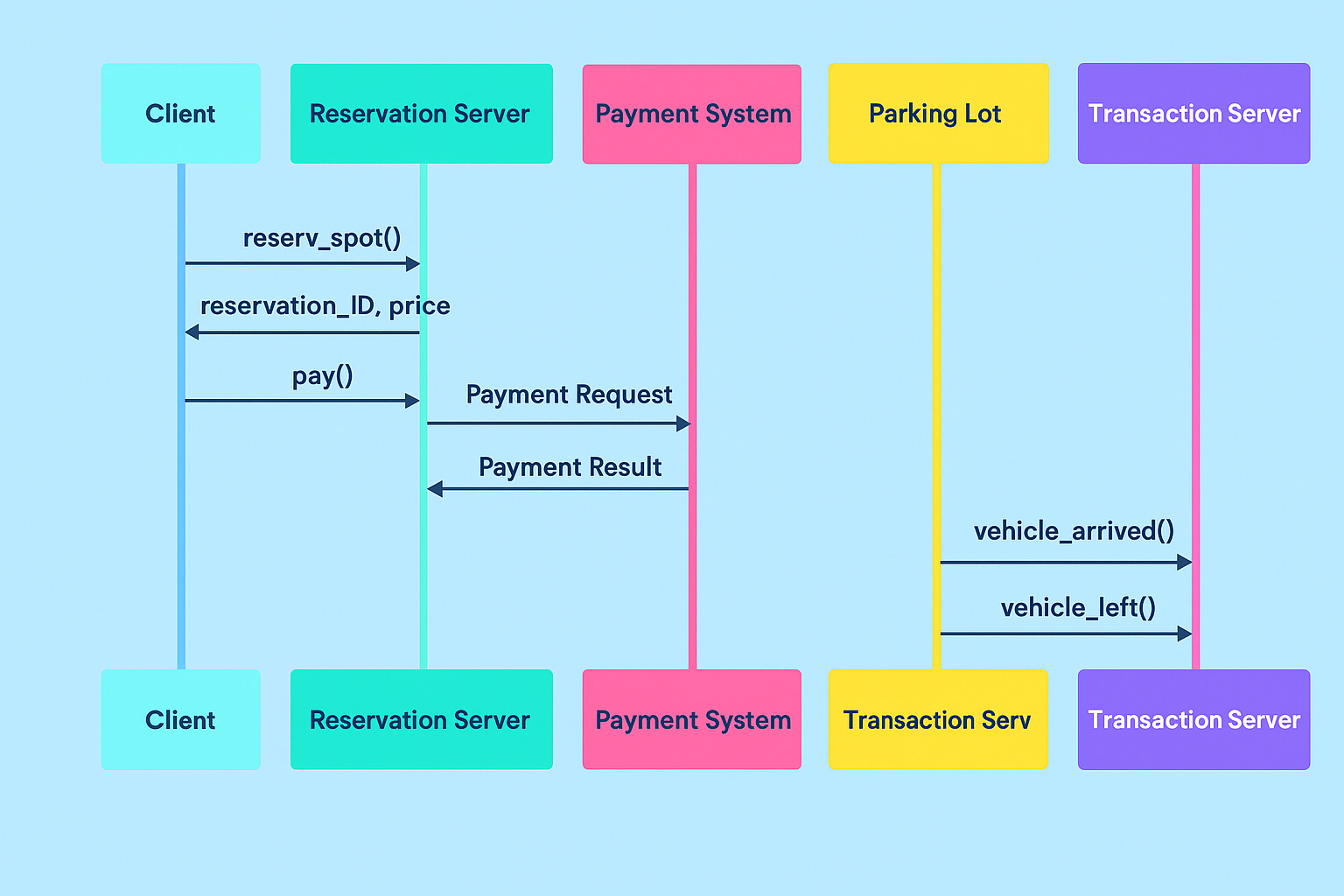
check_capacity(lot_ID, vehicle_type, start, end)→ returns open spots + price.reserve_spot(user_ID, lot_ID, vehicle_type, start, end)→ returns reservation ID + price.pay(user_ID, reservation_ID)
Parking Lot Gate APIs
vehicle_arrived(reservation_ID, time)vehicle_left(reservation_ID, time)
Step 4: Database Schema
Reservation Table
reservation_ID (PK)
lot_ID (FK)
user_ID (FK)
start_time, end_time
vehicle_type
payment_status (paid/unpaid/canceled)
completion_status (to be completed/fulfilled/canceled)
Lot, User, Vehicle, Capacity, Transaction, and Contact Info tables support the reservation system.
This normalized schema supports consistency and scalability.
Step 5: High-Level Architecture
Client → CDN → Rate Limiter → Load Balancer → API Gateway → Reservation Service
           ↘ Cache (Redis)
           ↘ Database (RDBMS)
           ↘ Message Queue → Payment Service
           ↘ Transaction Service → Parking Lot System
Key Components
CDN: Caches static content (UI, FAQs).
Rate Limiter: Protects from DDoS.
Load Balancer: Distributes traffic (weighted round-robin).
Reservation Service: Core service for booking and payments.
Transaction Service: Tracks arrivals/departures.
Redis Cache: Stores frequently accessed data (capacity, pricing).
Message Queue: Handles async payments + retries.
RDBMS: Ensures strong consistency for reservations.
Step 6: Core Algorithm – Finding an Open Spot
We represent time slots as bitmaps:
1 day → 96 slots (15 min each).
1 spot requires 96 bits/day.
To check availability:
Convert reservation (start, end) to bit indexes.
Build bitmap for requested slot.
Compare against each parking spot’s bitmap.
Return the first available spot (closest to entrance).
This algorithm is efficient given typical lot sizes (hundreds of spots). For further optimization, an Interval Tree could be introduced.
Step 7: Tradeoffs & Tech Choices
RDBMS vs NoSQL: RDBMS chosen for strong consistency, low data volume, and reliability in avoiding double booking. NoSQL (e.g., MongoDB) would provide better horizontal scaling but isn’t necessary at current scale.
Caching: Redis improves read-heavy operations (capacity checks).
Message Queue: Ensures payment retries without blocking reservations.
Step 8: Failure Scenarios
High demand events (e.g., Olympics near a lot):
Horizontal scaling of reservation service.
Rate limiting to prevent overload.
Database outage:
Replication across regions.
Fallback caches for read-only operations.
Inconsistent state: (vehicle leaves before arriving) → notify admin, auto-fix with assumptions.
Step 9: Future Improvements
Premium features: priority spots near entrances, valet service, car wash.
Global Load Balancing: route users to nearest data center.
More vehicle types: trucks, motorcycles, bicycles.
AI-driven dynamic pricing: adjust based on demand and events.
Final Thoughts
Designing a Parking Lot Reservation System looks simple on the surface, but scaling it globally introduces challenges in availability, consistency, and fairness. By combining a relational database, caching, message queues, and modular services, we can build a system that is reliable, consistent, and future-proof.
This design can be expanded with premium services, improved scalability, and smarter allocation algorithms, making it a strong foundation for a real-world parking management platform.
Other System Design Problems you may like to solve


![Design Twitter (X) - System Design Interview Question [Solved]](https://substackcdn.com/image/fetch/$s_!HFVt!,w_140,h_140,c_fill,f_webp,q_auto:good,fl_progressive:steep,g_auto/https%3A%2F%2Fsubstack-post-media.s3.amazonaws.com%2Fpublic%2Fimages%2Fed77349c-bfba-40ca-b807-4e0800a29e00_800x450.png)
